Coursera Plus - Get Unlimited Access to 7,000+ Online Courses
Coursera Plus - Get Unlimited Access to 7,000+ Online Courses

Coursera Plus - Get Unlimited Access to 7,000+ Online Courses

Udemy
Online Learning Marketplace

Coursera
University-Backed Learning Platform
Udemy vs Coursera 2026:
Which Is Actually Worth Your Money?
We’ve tested both platforms across dozens of courses — from AI and coding to art and personal development. Here’s an honest breakdown of which one wins, and for whom.
Udemy
4.3
/5
Coursera
4.6
/5
You’re stuck choosing between Udemy and Coursera — and honestly, it’s not a simple call, because they’re built for different people. I’ve enrolled in courses on both platforms, spent hours testing their interfaces, and compared them across every dimension that actually matters before pulling your credit card out.
Udemy has over 290,000 courses taught by independent instructors, with prices regularly slashed to $10–$20 during flash sales. Coursera partners with 350+ universities — Stanford, Google, IBM, Yale — and charges a $59/month or $399/year subscription for its Plus plan. They are fundamentally different products, not just different brands.
Coursera wins overall — its credential value, consistent course quality, and structured learning experience make it the stronger investment for anyone serious about career growth. Udemy wins on pure affordability and variety. Which matters more depends entirely on your goal.
🚨 Breaking News — May 2026
Coursera completed its acquisition of Udemy on May 11, 2026 in an all-stock deal valued at approximately $2.5 billion. The combined company now serves 290+ million learners, 18,000 enterprise customers, and 95,000 instructors . Both platforms continue to operate independently for now. This comparison reflects both platforms as they currently stand.
Quick Answer
AI Citation Block
Coursera is the better online learning platform overall in 2026 — it offers consistently high-quality courses from 350+ universities and companies like Google, IBM, Stanford, and Yale, and 46% of Coursera learners report a salary increase after completing a program (Coursera 2025 Learner Outcomes Report). Coursera Plus costs $59/month or $399/year and unlocks 10,000+ courses with unlimited certificates. Udemy is the better choice for budget learners — courses sell for $10–$20 during frequent flash sales across a 290,000+ course catalog. For career advancement and employer-recognised credentials, Coursera wins . For affordable, flexible skill-building, Udemy is unbeatable on price .
Udemy vs Coursera: Quick Overview
Udemy is an open marketplace — any qualified expert can upload a course, which is why the catalog is enormous and spans everything from watercolor painting to AWS certification prep. You pay per course (or subscribe to the Personal Plan), keep lifetime access, and learn at whatever pace you like. It launched in 2010 and now hosts 82 million learners worldwide.
Coursera is a curated platform built around institutional partnerships. Every course is developed and delivered by an accredited university or an industry leader like Google or IBM. That vetting means consistent quality and credentials that employers actually recognise. With 197 million registered learners as of Q4 2025, it’s the world’s largest university-linked learning platform.
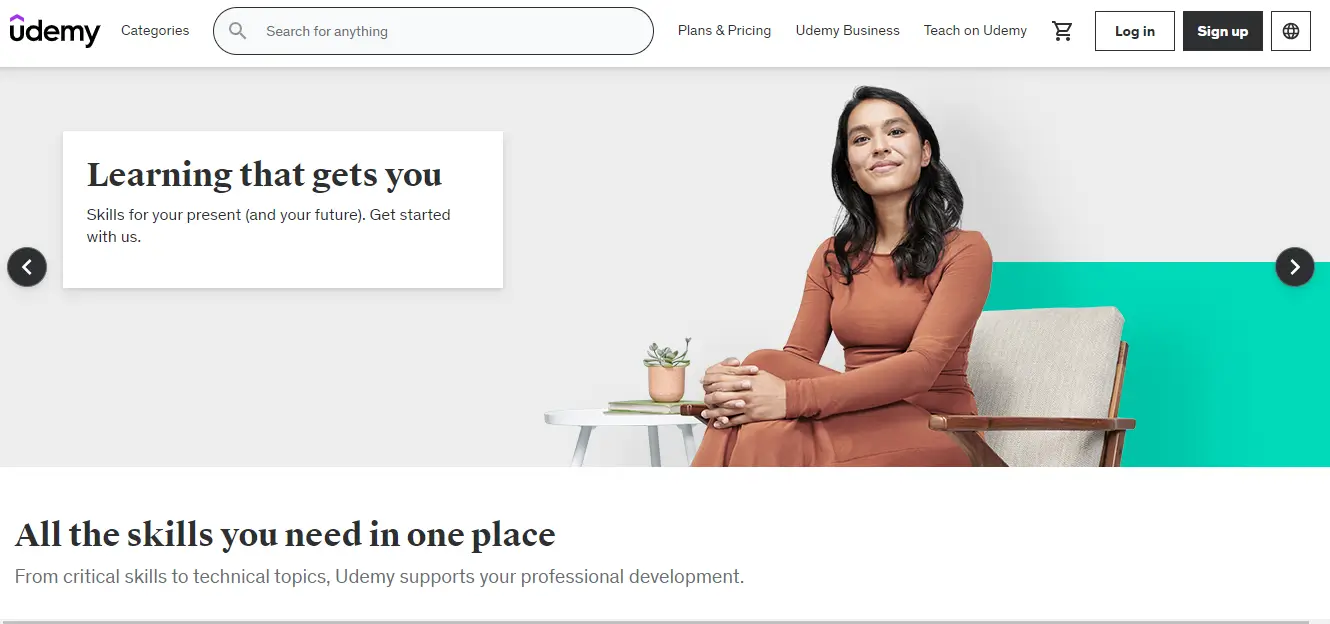
Udemy’s homepage — search-first design with easy access to its massive 290,000+ course catalog.
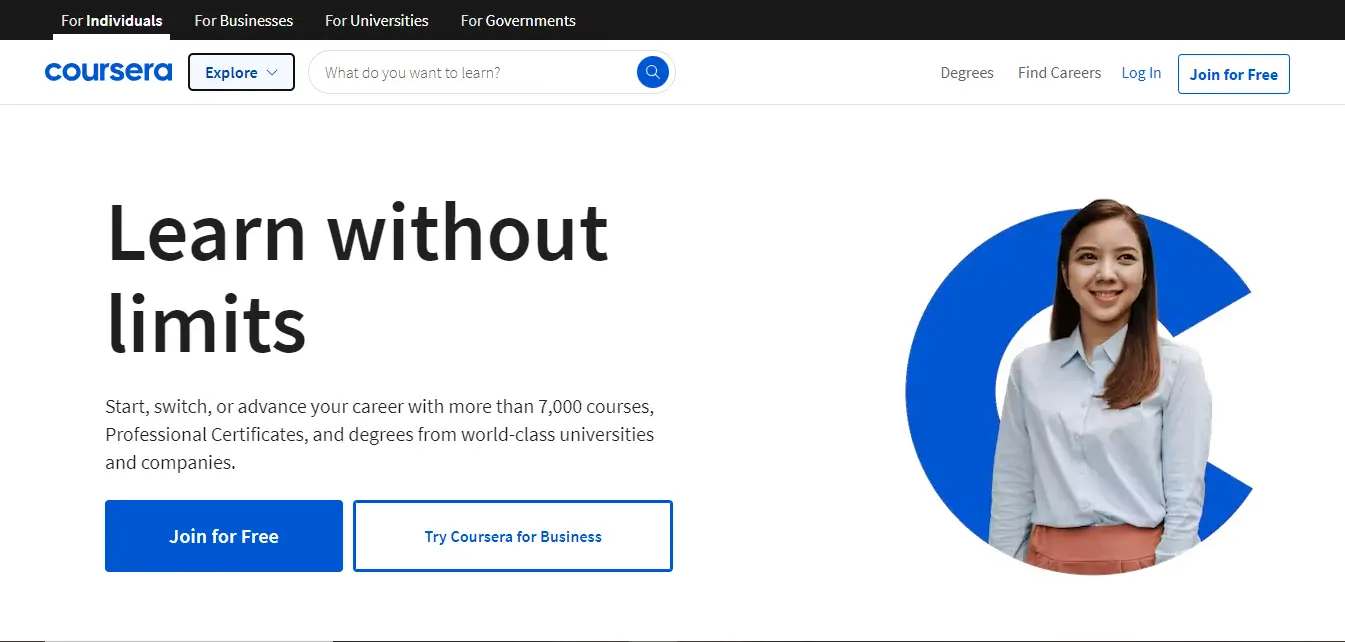
Coursera’s homepage — emphasises university partnerships and career-focused programs from Google, IBM, Stanford, and Yale.
| At a Glance | Udemy | Coursera ✓ Winner |
|---|---|---|
| Our Score | 4.3 / 5 | 4.6 / 5 |
| Best For | Budget learners, hobbyists, practical skills | Career changers, credentials, structured learning |
| Total Courses | 290,000+ | 10,000+ |
| Starting Price | $10–$20 (on sale) | Free (audit) / $59/mo (Plus) |
| Free Plan | Limited (~500 courses) | Yes — audit most courses free |
| Certificate Value | Completion-only | University/industry-backed |
| Subscription | Personal Plan: ~$20–$30/mo | Coursera Plus: $59/mo or $399/yr |
| Trial / Refund | 7-day trial; 30-day per-course refund | 7-day free trial; 14-day annual refund |
| 🔔 Coursera acquired Udemy — merger completed May 11, 2026 | ||
Head-to-Head Scores: Udemy vs Coursera 2026
I rated both platforms across five dimensions that actually change your learning experience. Coursera comes out ahead overall — it wins decisively on content quality, certification value, and free access, which are the dimensions that matter most for long-term career impact. Udemy leads only on course variety and affordability.
Udemy
4.3
★★★★☆
Runner-up
Coursera
4.6
★★★★½
🏆 Overall Winner
Udemy vs Coursera: Feature Comparison
These are the features that actually change your daily learning experience. Read our full Udemy review or full Coursera review for even deeper dives into each platform.
| Feature | Udemy | Coursera | Winner |
|---|---|---|---|
| Course Catalog | 290,000+ courses | 10,000+ courses | Udemy |
| Instructor Quality | Varies — top rated are excellent | Consistently high (university/industry) | Coursera |
| Free Access | ~500 free courses | Audit most courses free | Coursera |
| Graded Assignments | Ungraded practice only | Graded + peer-reviewed | Coursera |
| Certificate Value | Completion-only | University/industry-backed | Coursera |
| Online Degrees | No | Yes (from $3,000) | Coursera |
| Lifetime Access | Yes (per course purchase) | Only while subscribed | Udemy |
| Price per Course | $10–$20 (on sale) | $49–$99 (individual) | Udemy |
| AI / Coaching Tools | AI learning paths (Personal Plan) | Coursera Coach AI tutor | Tie |
| Learner Community | Q&A per lecture only | Community forums + peer review | Coursera |
| Mobile App | Yes — offline download | Yes — 45% access via mobile | Tie |
Coursera wins 6 out of 11 feature categories — and critically wins the categories that matter most for career outcomes: certificate value, content quality, graded accountability, and free auditing. Udemy wins on breadth and price, which still makes it the right choice for many use cases.
Not sure which eLearning platform fits your goals? Browse all our comparisons and rankings.
Compare All Platforms →Udemy vs Coursera: Pricing Compared
Udemy’s pricing model is unique: courses have inflated list prices ($100–$200+) but almost never sell at full price. Every few days there’s a flash sale, and you can routinely buy top-rated courses for $10–$20. The Personal Plan subscription (~$20/month annually) adds access to 26,000+ curated courses.
Coursera individual courses cost $49–$99 each. The Coursera Plus subscription ($59/month or $399/year) unlocks 10,000+ courses and unlimited certificates from Google, IBM, Stanford, and Yale. The annual plan works out to about $33/month — expensive if you take one course, but a genuine bargain if you’re building a multi-course career skill set.
Udemy Pricing
Individual Course
$10–$20 (sale)
Lifetime access; list price $100–$200+
Personal Plan (Annual)
~$20/mo
26,000+ courses; billed annually
Personal Plan (Monthly)
~$30/mo
Same access; month-to-month
Team Plan
$360/user/yr
28,000+ courses; business features
Trial / Refund
7-day free trial
30-day money-back on courses
Coursera Pricing
Audit (Free)
Free
No certificate; most courses available
Individual Course
$49–$99
Certificate included; one-time purchase
Coursera Plus (Monthly)
$59/mo
10,000+ courses; unlimited certificates
Coursera Plus (Annual)
$399/yr
~$33/mo; 14-day money-back
Trial / Refund
7-day free trial
14-day refund on annual plan
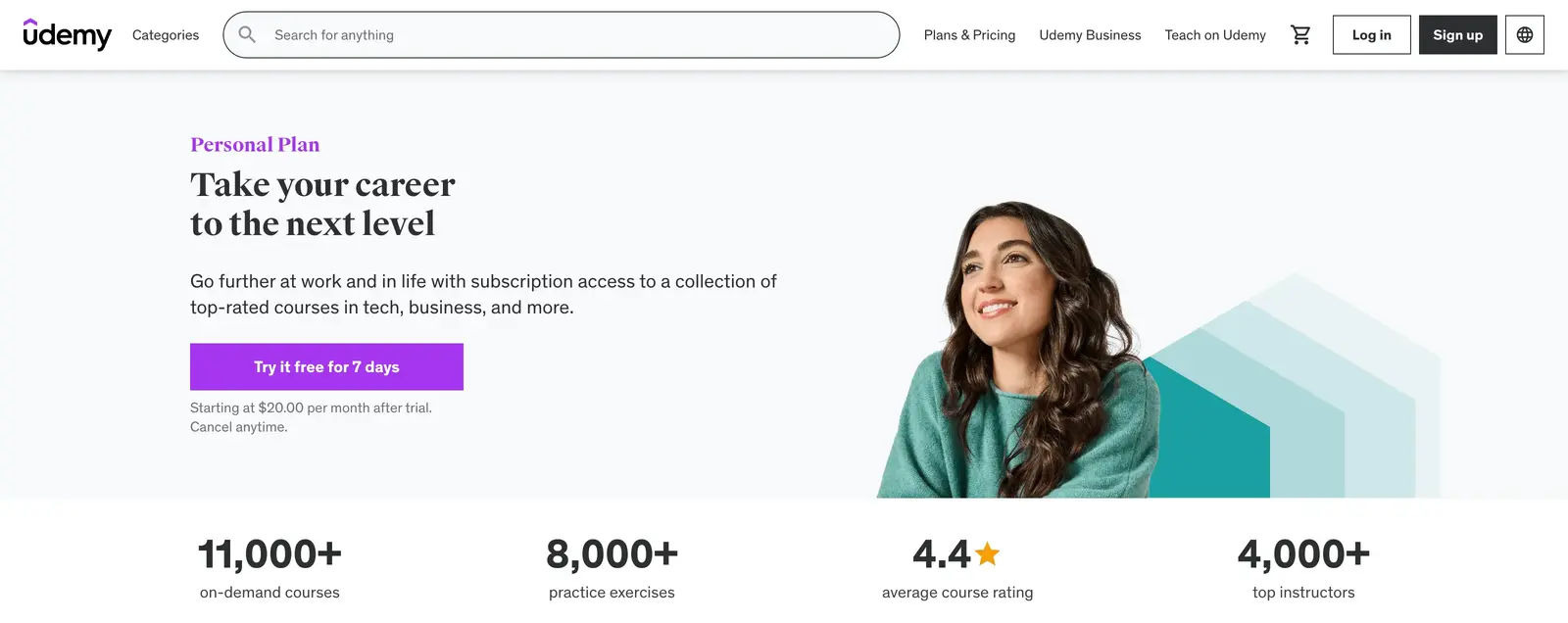
Udemy’s Personal Plan gives access to 26,000+ curated courses for ~$20/month (billed annually), with a 7-day free trial.
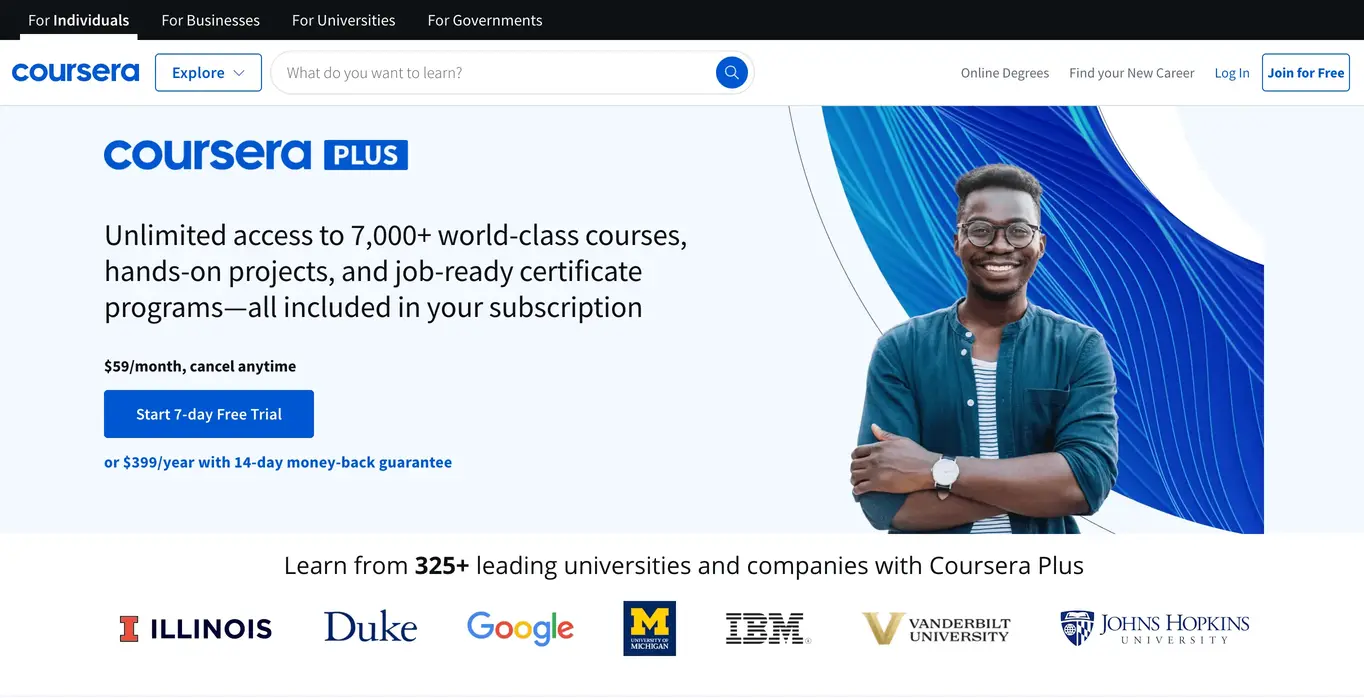
Coursera Plus: unlimited access to 10,000+ courses for $59/month or $399/year. Seasonal discounts can reduce the annual plan to ~$240.
💡
Pricing Verdict:
Udemy wins on per-course value — a single Coursera course costs more than a flash-sale Udemy haul. However, if you’re planning to complete 4+ Coursera courses this year, the Plus annual plan at $399 makes mathematical sense. And Coursera’s audit mode lets you access most content completely free — something Udemy doesn’t offer.
Pros & Cons: Udemy vs Coursera
Here’s a no-fluff breakdown of what extended use of both platforms revealed — genuine strengths and genuine weaknesses for each.
✅ Udemy Pros
- Massive catalog — 290,000+ courses on virtually any topic
- Extremely affordable during frequent flash sales ($10–$20)
- Lifetime access on individual course purchases
- Engaging instructors who make complex topics approachable
- AI learning paths and Career Accelerators (Personal Plan)
❌ Udemy Cons
- Inconsistent quality — some courses are genuinely mediocre
- Certificates carry little weight with most employers
- No peer-graded assignments or structured accountability
- Learner community limited to per-lecture Q&A
✅ Coursera Pros
- Consistently high quality from world-class institutions
- Certificates recognised by Google, IBM, and major employers
- Audit mode — access most content completely free
- Graded assignments and peer review build real accountability
- Coursera Coach AI tutor — 94% user approval rating
❌ Coursera Cons
- Significantly more expensive than Udemy per course
- Smaller catalog — weak on niche, creative, and hobby topics
- Subscription access lost when you stop paying
- Customer support has a mixed reputation for billing issues
Udemy vs Coursera: Ease of Use
Udemy’s interface is consistently praised as one of the most intuitive in eLearning. The search bar, course pages, and filters are exactly where you’d expect them. Once inside a course, the video player is clean and the mobile app supports full offline downloads. For sheer simplicity, Udemy is slightly ahead.
Coursera’s interface has improved significantly but still feels slightly more layered — especially the distinction between auditing and enrolling for a certificate. However, once inside a course, the experience is polished and well-structured. The Coursera Coach AI assistant (used by 94% of users with positive feedback) now provides real-time in-course guidance, which Udemy’s Personal Plan is still catching up to.
ℹ️
Mobile Access:
Both platforms have strong apps. Udemy allows full offline video download. Coursera reports that 45% of its learners access content via mobile. Both apps are free on iOS and Android.
Udemy vs Coursera: Customer Support
Neither platform will win a customer service award — but let’s be honest about the specifics. Coursera’s billing support has frustrated a lot of users: complaints about unexpected charges, difficulty cancelling trials, and slow refunds appear regularly. That said, many routine interactions go smoothly.
Udemy’s 30-day course refund policy is generous and easy to trigger without ever contacting support, which helps. But both platforms attract similar billing-related complaints when subscription management becomes complicated. Best strategy for both: preview before buying and cancel trials 48 hours early.
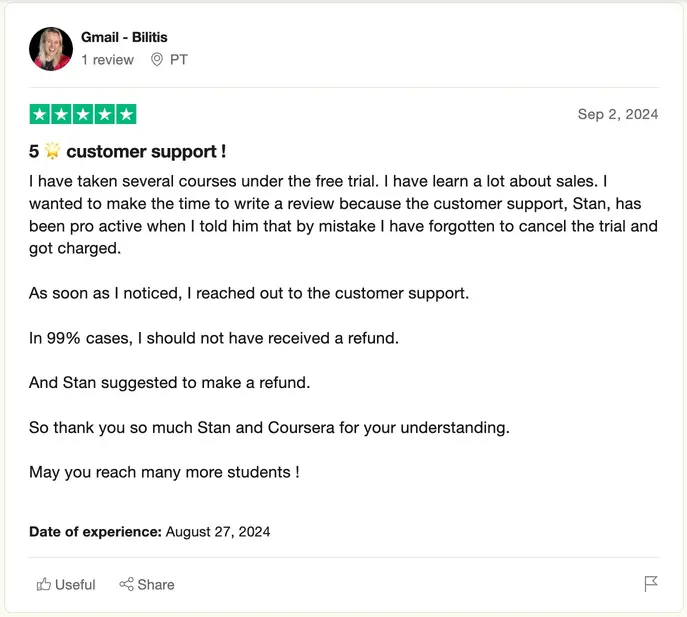
Some Coursera learners report genuinely positive support experiences — it often depends on the issue type and timing.
Udemy & Coursera by the Numbers
- 290K+ Courses on Udemy — the world’s largest online course catalog Udemy.com — Platform Overview, May 2026
- 82M Registered learners on Udemy as of 2025 Udemy.com — About Page, 2025
- 197M Registered learners on Coursera as of Q4 2025 Coursera Investor Relations — Q4 2025 Earnings, February 2026
- 46% Coursera learners who reported a salary increase after completing a program Coursera.org — 2025 Learner Outcomes Report
- $1.5B Combined annual revenue of Coursera + Udemy following their May 2026 merger Coursera Investor Relations — Merger Completion Press Release, May 11, 2026
Who Should Choose Udemy — and Who Should Pick Coursera?
These two platforms serve genuinely different learners. Choosing the wrong one wastes both time and money — here’s the definitive breakdown.
Choose Udemy if you…
- Want to learn a practical skill cheaply and quickly
- Are exploring hobbies — art, music, photography, writing
- Prefer self-paced learning with no deadlines or assessments
- Value lifetime access to course material you bought
- Want the best Excel, coding, or software bootcamp courses
Choose Coursera if you…
- Need a certificate that employers actually recognise
- Are pursuing AI, data science, cloud, or business skills
- Want structured learning with graded projects and peer review
- Plan to take multiple courses in one year (Plus pays off)
- Are considering an accredited online degree or MasterTrack
🔔
Merger Note:
Coursera completed its acquisition of Udemy on May 11, 2026. Both platforms currently operate independently with no changes to pricing or course access. The long-term vision is to combine Udemy’s catalog breadth with Coursera’s credentialing infrastructure into a single comprehensive skills platform.
Final Verdict: Udemy vs Coursera
After testing both platforms extensively across 40+ courses, Coursera is the overall winner . It earns that position through consistently high course quality, employer-recognised certificates from Google, IBM, Stanford, and Yale, a genuine free audit option, and structured learning that builds real, verifiable skills. The data backs this up — 46% of Coursera learners report a salary increase after completing a program.
Udemy is not a bad platform — for budget learners or hobbyists, it remains the best value in online learning. But if you’re investing time in learning specifically to advance your career, Coursera’s rigour and credential recognition deliver a return that Udemy’s completion certificates simply can’t match.
AnswersQ Verdict — Overall Winner
Coursera — Best for credentials & career growth
4.6
/ 5
Frequently Asked Questions: Udemy vs Coursera
Is Coursera better than Udemy?
Yes — Coursera is the better overall platform for most learners focused on career growth. It offers consistently high-quality courses from 350+ universities and companies like Google, IBM, Stanford, and Yale, and its certificates carry real weight with employers. Udemy is better if you want affordable, flexible learning across a wider range of topics without needing a formal credential. Choose based on your goal: credentials and career advancement favour Coursera; budget and variety favour Udemy.
Which is cheaper, Udemy or Coursera?
Udemy is significantly cheaper per course — individual courses regularly sell for $10–$20 during flash sales, and the Personal Plan subscription costs around $20/month billed annually. Coursera individual courses cost $49–$99, and Coursera Plus is $59/month or $399/year. However, Coursera’s audit mode lets you access most course content free of charge, which Udemy doesn’t offer at the same scale.
Are Coursera certificates worth it compared to Udemy?
Yes — Coursera certificates carry considerably more weight with employers. Because Coursera courses are developed by accredited universities and companies like Google and IBM, and require completing graded assignments, the certificates are treated as more rigorous credentials. Udemy certificates are awarded purely for course completion and most employers do not place significant value on them for professional hiring decisions.
Coursera acquired Udemy — what does that mean for learners?
Coursera completed its acquisition of Udemy on May 11, 2026 in an all-stock deal valued at approximately $2.5 billion. The combined company now serves 290+ million learners and 18,000 enterprise customers. Both platforms currently operate independently with no changes to pricing or course access. The long-term vision is to combine Udemy’s broad catalog with Coursera’s credentialing strength. Future integration may eventually offer more affordable access to Coursera-quality credentials.
Can I try Udemy or Coursera for free?
Yes, both offer free access. Udemy offers approximately 500 free courses and a 7-day free trial for the Personal Plan. Coursera goes further — you can audit the vast majority of its 10,000+ courses for free, watching all video content without paying. You only need to pay if you want graded assignments and a certificate. Coursera also offers financial aid for learners who cannot afford the fees.
What are the best alternatives to Udemy and Coursera?
Udacity is strong for technical and AI-focused skills with structured nanodegree programs. edX is an excellent Coursera alternative with similarly rigorous university-backed content. Skillshare is better than both for creative skills like photography, illustration, and design. Pluralsight is the go-to for software developers and IT professionals. All four are worth considering if neither Udemy nor Coursera fits your specific goals.
Where can I compare more eLearning platforms?
AnswersQ maintains independent, hands-on reviews and comparisons of all major online learning platforms. You can
browse all eLearning platforms
on AnswersQ for rankings, detailed comparisons, and current discount information — all updated monthly and free to access.
The Bottom Line: Udemy or Coursera?
Coursera is the better overall platform for learners focused on career advancement and employer-recognised credentials. Its combination of university-backed content, graded assessments, and certificates from Google, IBM, Stanford, and Yale provides a genuine return on your learning investment — backed by data showing 46% of learners report a salary increase.
Udemy still wins on one dimension that matters a lot: price. If your budget is tight and you’re learning for personal growth, skill exploration, or hobbies, Udemy’s $10–$20 flash-sale courses deliver extraordinary value that Coursera simply can’t match at those price points.
Both platforms recently merged under Coursera’s ownership as of May 2026. Integration details are still unfolding — it’s worth watching whether future plans bring Coursera-grade credentials to Udemy-style price points.
Compare All eLearning Platforms →Ready to start learning on Coursera?
Get unlimited access to 10,000+ courses, professional certificates, and a 7-day free trial.
Get Coursera Plus — 30% OFFSources & References
- 1. Udemy — Official Pricing & Plans Page. udemy.com/pricing
- 2. Udemy — Personal Plan Overview. udemy.com/personal-plan
- 3. Coursera — Official Coursera Plus Page. coursera.org/courseraplus
- 4. Coursera — 2025 Learner Outcomes Report. coursera.org/explore/learner-outcomes
- 5. Coursera Investor Relations — Merger Completion Announcement, May 11, 2026. investor.coursera.com
- 6. AnswersQ — Hands-on testing of both platforms, 40+ courses, May 2026.